
The Survivor
“I’m just trying to get through today.”
“You genuinely want to make changes but somehow keeping them going has become harder than starting them.”
You're hopeful, adaptable and someone who keeps trying. When you decide you want something to change, you mean it. You make the plan, feel motivated by the fresh start and genuinely believe that this time you're going to follow through.
Then life happens. Work gets busier, you sleep badly, your energy drops or something unexpected needs your attention and the things you'd planned for yourself begin to slip. One missed workout becomes a week without training, the meals you were going to prep don't happen and before long, you're telling yourself you'll get back to it when things calm down.
After enough experiences like this, it's easy to start questioning your ability to stick with anything, particularly when you've started again more times than you'd care to remember.
The problem isn't that you don't want it enough. It's that you've become used to measuring your ability to follow through against the weeks when you have the most capacity, rather than learning how to keep going when you have less.
This is not a personality type. It is the protective pattern your brain runs automatically when you are under pressure.
Emotional need
To feel safe — to know that today will not ask more of you than you have left.
Protective strategy
Conserve and comply. Your brain narrows the world to what must be survived now, follows whatever is easiest, and defers anything that costs energy.
Coaching strategy
Regulate first, then decide. We rebuild capacity with low-cost daily actions and nervous-system anchors so change stops feeling like one more thing to survive.
Mind Monkey™
The Firefighter — “Not now. Deal with the next thing first and think about yourself later.”
Power Shift™
Regulate before you plan. Before you decide anything today, take sixty seconds: feet on the floor, slow the out-breath, and let your shoulders drop. One minute of safety first. Your brain will tell you there is no time — that is exactly the pattern. Regulation is what makes the next decision cheaper.
Self-belief — “I want to believe I can follow through.”
“I'll get back to it when I have more capacity.”
When life feels demanding, your brain looks ahead to a time when you'll have more energy, time or headspace.
It sounds completely reasonable because sometimes you genuinely do need to pull back. The difficulty comes when waiting becomes your automatic response every time the original plan no longer fits.
Monday becomes next Monday, the fresh start keeps moving and every promise you don't quite manage to keep gives your Mind Monkey™ a little more evidence for something you're already worried might be true: “Maybe I'm just not very good at sticking with things.”
That's where we need to change the conversation.
Menopause can make this pattern particularly frustrating because your capacity may not feel as predictable as it once did. Sleep can change, energy can fluctuate and symptoms, stress, work and everything else happening in your life can mean that what felt perfectly manageable last week feels completely different this week.
Your body doesn't need another ambitious plan designed around your best week. It needs something that can flex with the week you're actually having.
That might mean doing a shorter workout rather than skipping it altogether, putting together a simple protein-rich meal when you don't have the energy to cook what you'd planned, or taking a ten-minute walk when the hour you thought you had has disappeared.
For you, the size of the action matters far less than the fact that you followed through, because every time you do, you're giving yourself another piece of evidence that you can rely on yourself.
- Hopeful
- Adaptable
- Compassionate
- Resilient
- Able to pick yourself up and try again
That willingness to keep coming back matters. It tells me you haven't given up on yourself, even if your confidence in your ability to follow through has taken a few knocks along the way.
You don't need more motivation to begin again. Your real opportunity is learning how to use that adaptability before you abandon the plan, so that when life changes, the plan can change with it.
You may have become so used to starting again that you don't always notice the moment when adapting would have been enough.
- Perhaps you planned three workouts and suddenly only have time for one.
- You intended to cook from scratch but get home exhausted.
- You'd been building a routine and then have three terrible nights of sleep.
If the original plan is no longer possible, it can feel easier to put the whole thing on hold until you have enough capacity to do it properly again.
The problem is that you're then judging your consistency by whether you followed the original plan, rather than whether you stayed connected to what mattered.
Your blind spot isn't that you can't follow through. It's that you may not yet recognise adaptation as follow-through.
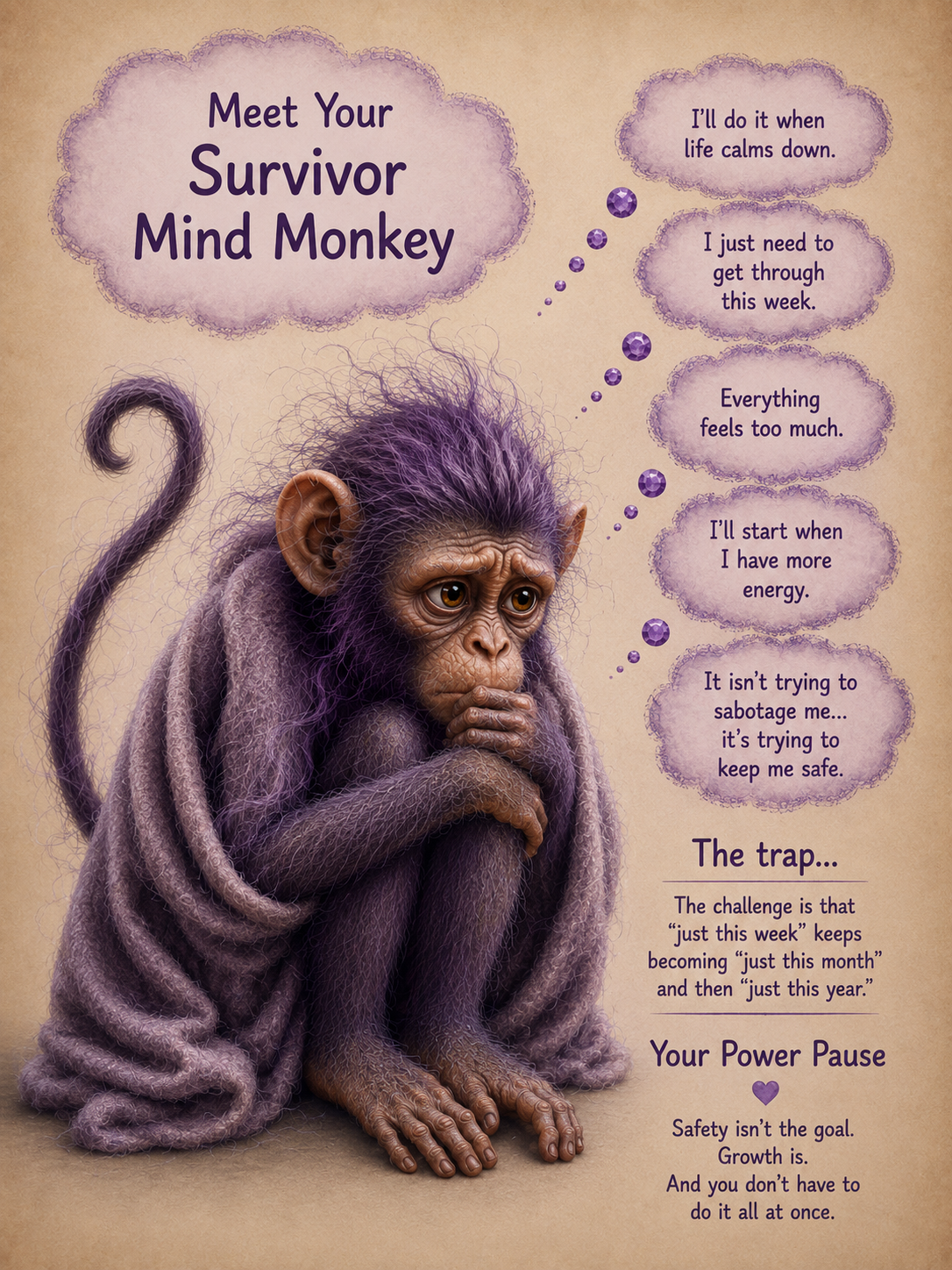
“I'll do it when I have more capacity.”
“I'll get myself going again next week.”
“Things are just too busy at the moment.”
“I'll start again when I've got more energy.”
“There's no point in only doing ten minutes.”
Sometimes that voice will be right. There will be times when rest genuinely is the most useful thing you can do and forcing yourself through something isn't going to help.
What I want you to start noticing is whether you really need to stop, or whether the action simply needs to become smaller.
The next time the thing you planned no longer fits the day you're having, rather than immediately postponing it, ask: “What's small enough that I can follow through today?”
Maybe you still do exactly what you planned. Maybe you do half of it, ten minutes of it or something completely different that still supports what you're trying to achieve.
The goal is to stop measuring consistency by how much you managed to do and start recognising the value of staying connected to the thing you said mattered, even when that means doing less than you'd originally planned.
Every time you do that, you give yourself evidence that your circumstances can change without everything having to stop.
You don't need another perfect Monday or a sudden burst of motivation to become someone who follows through. You just need enough experiences of keeping promises to yourself that you start believing you can rely on you again, and those promises don't need to be impressive to count.
Sometimes following through will look exactly as you planned and sometimes it will mean adapting because life, your energy or your body had other ideas.
Both count because for you, tiny really is mighty when it keeps you moving.
POWER30 keeps it small on purpose: thirty days of small, achievable daily actions that rebuild capacity first, so change stops feeling like one more thing to survive.