
The Caregiver
“Everyone else comes first.”
“You're naturally tuned into what other people need, but your own needs have become much easier to negotiate.”
You're thoughtful, dependable and probably someone people know they can turn to. You remember the things that matter, notice when someone isn't quite themselves and often step in without needing to be asked because caring for other people isn't something you have to work particularly hard at. It's simply part of who you are.
Those qualities have likely shaped some of your strongest relationships and they're absolutely not something we want to change. The difficulty comes when considering everybody else becomes so automatic that you stop noticing how often you are the person being left out of the decision.
You intended to exercise, but someone needs you. You were going to eat lunch, but there's something that needs sorting first. You need an early night, but there's one more thing you could do for somebody else. None of those decisions feels particularly significant on its own, which is precisely why the pattern can be difficult to spot.
You're not deliberately choosing everyone else instead of yourself. You've simply become very practised at making your own needs the easiest ones to move.
This is not a personality type. It is the protective pattern your brain runs automatically when you are under pressure.
Emotional need
To feel secure in your relationships — to know you are needed, and that nobody has been let down.
Protective strategy
Anticipate everyone else’s needs first. Looking after others keeps the connection safe and quiets the worry, so your own needs slide to the bottom automatically.
Coaching strategy
Build boundaries without guilt. We practise including yourself in the care you give, one protected non-negotiable at a time, and name the guilt as pattern rather than truth.
Mind Monkey™
The Guilt Gremlin — “If you take that time for yourself, you’re letting them down.”
Power Shift™
Put one non-negotiable back on your list. Choose one small thing your body needs daily — a proper lunch, a walk, lights out at a set time — and protect it as fiercely as you would protect it for someone you love. When the guilt arrives, name it out loud: “That’s the pattern, not the truth.”
Permission — “Everyone else comes first.”
“Don't be selfish.”
Your brain has learned to pay close attention to what other people need from you and when those needs compete with your own, your Mind Monkey™ has a very persuasive message.
So you accommodate, rearrange or tell yourself that what you need can wait. Sometimes that's exactly what you want to do. Caring for somebody you love, helping a friend or changing your plans for your family isn't automatically a problem.
The blind spot appears when your needs are always the ones considered optional.
Menopause can make that pattern increasingly difficult to sustain because your body may start asking for things you haven't traditionally been very good at protecting. Sleep and recovery matter. Maintaining muscle and bone becomes increasingly important, as do nourishing yourself properly, managing stress and having enough time and energy for your own health.
The answer isn't to suddenly put yourself first in every situation or stop being available to the people you love. That's unlikely to feel like you and it isn't necessary. What matters is learning to include yourself in the equation.
Sometimes someone else genuinely will need to come first. At other times, you may realise you've automatically said yes without considering what that yes requires from you.
That's where boundaries become useful, not as a way of shutting people out, but as a way of making sure there is room for you too.
- Compassionate
- Loyal
- Thoughtful
- Supportive
- Highly aware of the people around you
You notice things. You listen. You remember and you often understand what somebody needs without them having to spell it out. Those qualities create connection and make you someone people feel they can rely on.
Caring isn't the behaviour we're trying to change. We're simply widening the circle of people you consider worthy of that care to include you.
It's because considering other people comes so naturally, that you may not always recognise the number of small compromises you're making on your own behalf.
- You might tell yourself missing one workout doesn't matter.
- Eating later is fine.
- You'll get some time for yourself tomorrow.
- You may confuse having a boundary with letting somebody down, particularly when you know you could help.
Individually, those decisions may be completely reasonable, but when your needs are repeatedly the easiest ones to move, they begin to add up.
Your blind spot isn't caring too much. It's believing that being capable of meeting somebody else's need automatically means you should. You get to consider what saying yes costs you before deciding whether you still want to say it.
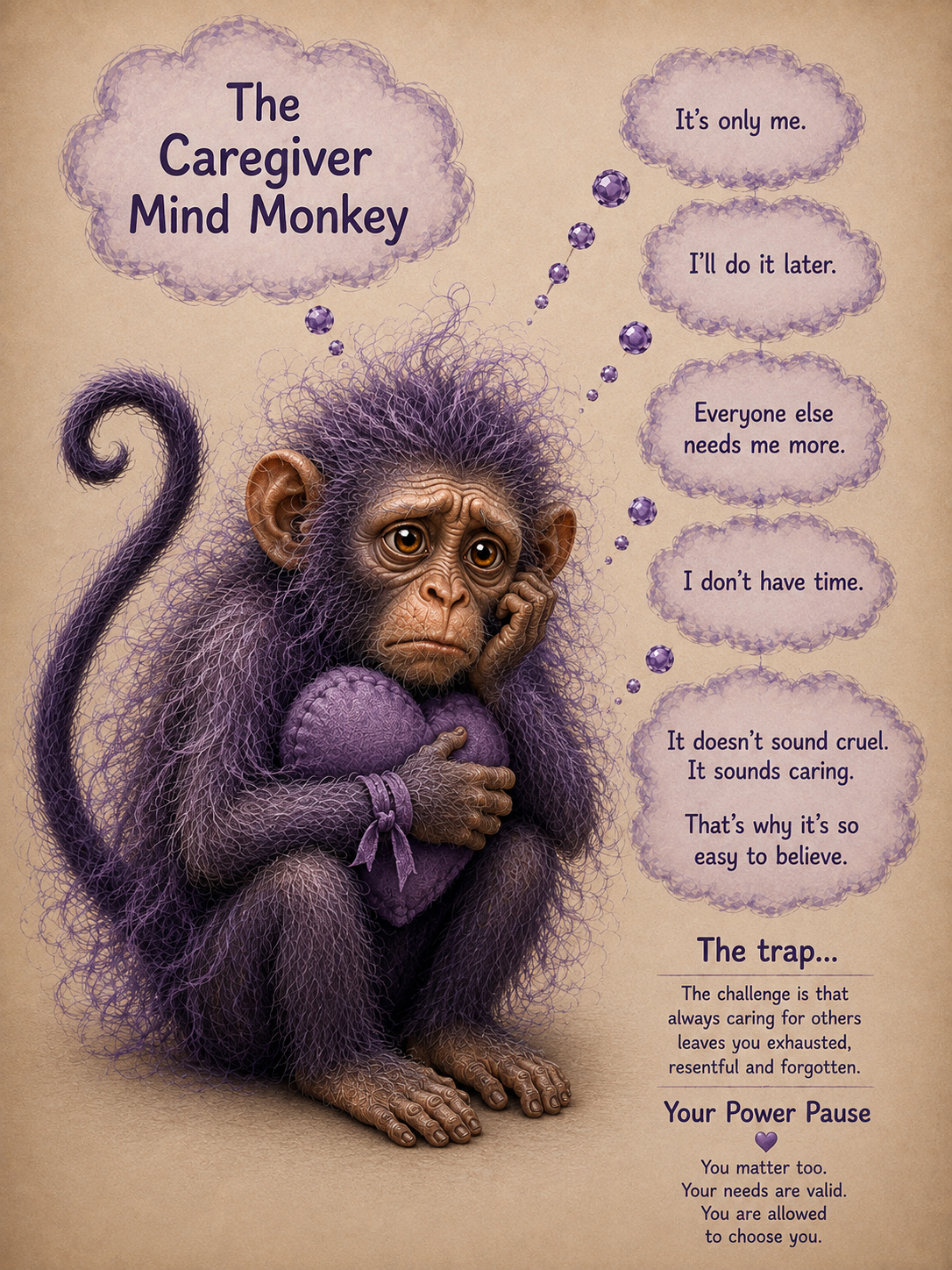
“Don't be selfish.”
“They need me more right now.”
“Mine can wait.”
“It's easier if I just do it.”
“I feel bad saying no.”
The tricky thing about this Mind Monkey™ is that it can sound remarkably similar to kindness. Sometimes helping absolutely is the choice you want to make.
The skill is noticing whether you're choosing to give or automatically removing yourself from consideration. There's a big difference.
The next time somebody needs something from you, particularly when it competes with something you'd planned for yourself, give yourself a moment before automatically responding.
Ask: “What do they need, what do I need, and what feels fair to both of us?”
You may still say yes. You may say not now, offer something different or realise that this is one of those occasions when what you need deserves to stay exactly where it is in the diary.
The Power Shift™ isn't choosing yourself every time. It's giving yourself permission to be part of the decision.
You don't need to become less caring, less generous or less available to the people who matter to you. Your ability to care deeply is one of your strengths.
What we're changing is the assumption that your needs should automatically be the most flexible ones in the room.
There will be times when you willingly put somebody else first because that's the choice you want to make. There should also be times when you protect something that matters to you without needing to justify why.
You don't have to put yourself first every time. You just need to stop automatically putting yourself last.
POWER30 gives Caregivers permission and structure: thirty days of small daily actions that make room for you too, with support and accountability to help you keep showing up for yourself.